Home & Seasonal
 Get the Free Printable PDF Pattern
Join the CrochetRooms newsletter and we’ll email you the printable PDF version of this pattern.
Table of Contents
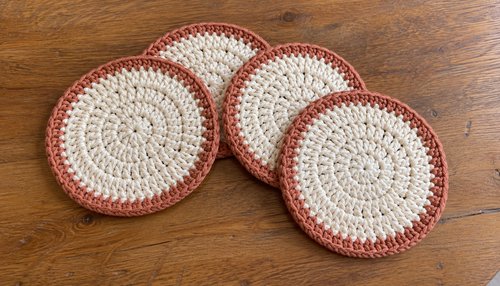
Crochet coasters are the little project with a big payoff. They protect your furniture, soak up condensation, and add a handmade touch to every room, all from a few yards of cotton yarn and about twenty minutes of stitching.
Below I am sharing everything about making them: the flat circle construction, why cotton is the only fiber to use, and how to keep a whole set perfectly matching. At the end, you can grab my free crochet coasters pattern to make the full set yourself.
A coaster is the rare handmade item you actually use every single day. Every coffee, every cold drink, every warm mug lands on one, and a crocheted set looks so much better than a stack of paper napkins or a bare table ring. They are also the perfect beginner project: one simple motif, repeated, with no shaping or sewing.
They are wonderfully giftable too. One coaster takes about 20 minutes, so a matching set of four or six comes together in a single evening. Tie the stack with a ribbon and you have a housewarming or hostess gift that looks far more expensive than the yarn it cost. Shoppers at craft fairs buy them in sets for the same reason.

A great crochet coaster has three qualities: it lies flat, it absorbs, and it looks intentional. Each one comes from a simple choice in the pattern.
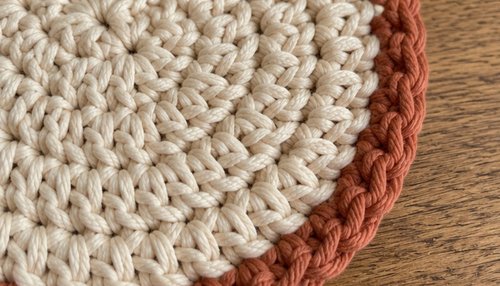
The coaster starts with a magic ring and grows through four rounds of evenly spaced double crochet increases: 12, 24, 36, then 48 stitches. The classic increase math keeps the circle lying perfectly flat instead of curling into a bowl. If your coaster ripples, your tension is too tight; if it cups, work one fewer increase. The easy coaster pattern from Start Crochet shows the same flat-circle math at the same size.
Cotton is the only right fiber for coasters. It absorbs condensation instead of letting it pool, it survives hot mugs without melting or going shiny, and it washes well when coffee spills. Acrylic yarn looks similar but repels water and can soften under heat, so save it for wearables. Worsted-weight (#4) cotton like dishcloth cotton is the standard choice, and the boho coaster pattern from Jewels and Jones uses the same fiber at the same 4-inch size.
The final round is worked in a contrast color, which gives the set a finished, designed look with zero extra effort. Work the same number of stitches as the round before, one double crochet in each stitch, so the edge stays flat. Keep your color changes tidy: finish the last yarn-over of the old color with the new one, then weave the ends into the stitches on the back. Our crochet tree skirt uses the same tidy color-change technique on its round base.
Worsted-weight (#4) 100% cotton yarn is the best choice for crochet coasters. Dishcloth cotton is inexpensive, thirsty, and comes in every color from farmhouse neutrals to bold brights. Use a US G-6 (4.0 mm) hook, which gives a dense but flexible fabric at this size.
Each coaster finishes about 4 inches (10 cm) in diameter and uses about 21 yards of yarn, so a set of four needs roughly 84 yards total. Want larger coasters for big mugs? Add one more increase round of 60 stitches and the diameter grows to about 5 inches. The same round base appears in our crochet wreath, which starts as a flat circle just like this.
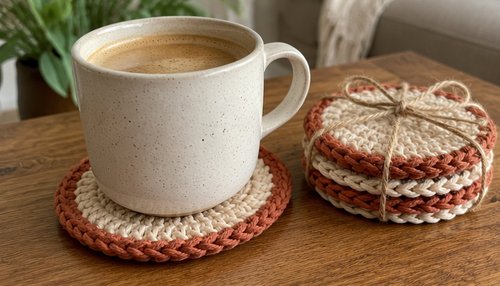
A matching set of four to six coasters is the sweet spot: enough for the living room or the patio table, all in the same colors. Keep the palette tight, two colors alternating, or one main color with a contrast edge, so the set reads as a set. Mix-and-match rainbows are fun for kids but harder to gift.
To present them, stack the coasters, tie with cotton twine or ribbon, and add a small tag. They make excellent housewarming gifts, teacher gifts, and stocking stuffers. Pair them with our crochet shawl for a cozy handmade gift bundle, or place a few under holiday mugs on a tray for a festive centerpiece.
Looking for a crochet coasters pattern free to download? I wrote the complete Crochet Coasters pattern as a printable PDF: the 4-inch round motif, the contrast-color edge, and my tips for keeping every coaster in the set flat and matching. It is free for our newsletter subscribers, so use the signup box at the top of this article to get your copy.
What size are the finished crochet coasters?
About 4 inches (10 cm) in diameter each, when worked in worsted-weight cotton with a 4.0 mm hook.
What yarn is best for crochet coasters?
Worsted-weight (#4) 100% cotton, like dishcloth cotton. Cotton absorbs moisture and handles heat; avoid acrylic for coasters.
What hook size do I need?
A US G-6 (4.0 mm) hook, which gives a dense, flat fabric at this size.
How much yarn does one coaster use?
About 21 yards, so a set of four needs roughly 84 yards total.
Why do my coasters curl up?
Uneven increases are the usual cause. Make sure each round has the full stitch count and the increases are evenly spaced; blocked coasters also lie flatter.
Can a beginner crochet coasters?
Absolutely. This is one of the best first projects: just chains, double crochet, and slip stitches in the round. Rated easy.