Home & Seasonal
 Get the Free Crochet Mandala Pattern
Join the CrochetRooms newsletter to download the free printable PDF pattern.
A bare wall can make a whole room feel unfinished, and a crochet mandala is one of the gentlest ways to fix that. A round of soft color, stretched on a wooden hoop, turns an empty patch of wall into something calm and handmade.
If you love projects that grow round by round, you will love this one: simple stitching that ends as wall art.
Mandalas have been stitched in circles for a long time, and the reason is simple: a circle is restful to look at. The rounds grow slowly outward, one color at a time, and the finished piece holds that calm feeling.
The shape does most of the work. A round mandala softens a square room, and its rings of color draw the eye without shouting. Hang one above a reading chair and the corner feels finished.
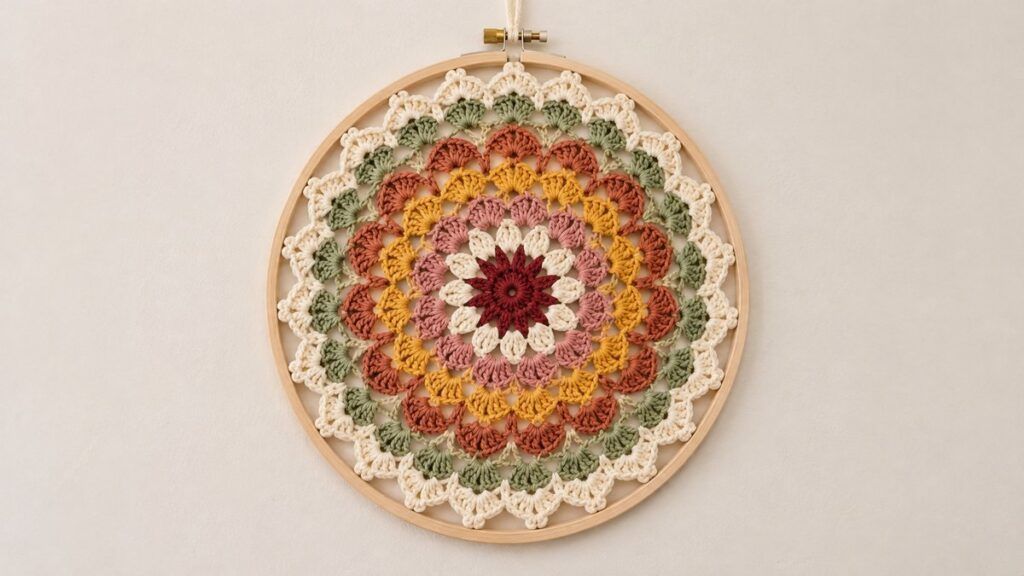
This mandala asks very little of your yarn stash: small amounts of 4 ply cotton in six colors, one per round, and a 3.0 mm hook. The finished circle is about 11 inches (28 cm) across and fits a 12 inch (30 cm) hoop with a gentle stretch.
A mandala wall hanging makes a thoughtful gift: clearly handmade, yet finished in a couple of relaxed evenings. It suits a new home, a birthday, a handmade Christmas gift, or a friend who loves handmade things.
For more handmade wall ideas, see our crochet wall hanging ideas, where simple stitches become art for the wall.
A mandala and a doily can look alike in a photo, so it helps to be clear about what this piece is. A doily lies flat on a table, under a vase or a lamp.
This mandala is made to be looked at on a wall. It is blocked flat, stretched inside a wooden embroidery hoop, and hung from a small yarn loop at the top. The hoop holds the circle taut and round, the loop carries the weight, and the whole piece faces the room.
The same eleven rounds can look very different with a change of colors.
The featured version is the sunset mandala from the printable pattern: a burgundy center, then rings of cream, dusty pink, mustard yellow, terracotta, and sage green, closing with a cream picot edge. The warm colors glow against a pale wall.
Pair it with a cushion in the same sunset colors, like our crochet pillow cover, and the two pieces tie a room together.
For a nursery or a calm bedroom, work the same rounds in soft pastels: pale pink, butter yellow, mint, and cream. The open V stitch rounds keep the piece light and airy.
If you prefer a quieter look, work the whole mandala in one color. A single cream or soft grey lets the texture do the talking: the V stitches, the open chain spaces, and the sixteen picot petals show up clearly. It is also the fastest way to make one, with no ends to weave in between rounds.
For the sunset mandala in the printable pattern, the source uses small amounts of 4 ply (fingering) cotton, in the style of Scheepjes Cotton 8, with a 3.0 mm hook. You will change color for every round, so you need six colors in small amounts. The source gives no yardage and no gauge, and none has been invented here: gauge is not crucial, since the mandala is blocked to size before it goes on the hoop.
The finished circle is about 11 inches (28 cm) across with the stated yarn and hook, and it fits a 12 inch (30 cm) embroidery hoop with a little stretch. A heavier yarn and a larger hook make a larger circle, which needs a larger hoop. You can read the original free design on Annie Design Crochet for inspiration.
For a smaller mandala on a 10 cm hoop, compare the easy mandala wall hanging from The Crochet Swirl: 4 ply cotton, a 2.5 mm hook, about 6 cm across after Round 3 and about 8 to 8.5 cm after Round 4. You can read that free design on The Crochet Swirl for inspiration.
A pale wall loves warm colors: burgundy, terracotta, mustard, and dusty pink stand out without clashing. A dark wall loves light colors: cream, pale sage, and soft yellow. Two or three colors are enough for a calm look, while six colors in sunset order bring a playful feeling.
Block the mandala before you mount it: pin it into a flat circle and steam it gently, so the rounds lie even and the petals sit neatly. Attach it to the hoop with a yarn needle, stitching each petal to the hoop in turn, and add a small chain loop at the top for hanging. A wooden hoop suits a warm room, a plain metal hoop suits a cooler one.
A doily lies flat on a table, under a vase or a lamp. A crochet mandala wall hanging is blocked flat, stretched inside a hoop, and hung on a wall from a yarn loop. The hoop and the loop are what make it wall art instead of table linen.
A smooth 4 ply (fingering) cotton is a strong choice: it shows the stitches clearly, holds its shape well after blocking, and comes in many colors. The source pattern uses 4 ply cotton in the style of Scheepjes Cotton 8, with a 3.0 mm hook.
The mandala in the printable pattern is about 11 inches (28 cm) across, and it fits a 12 inch (30 cm) embroidery hoop with a little stretch. A heavier yarn and a larger hook make a larger circle, which needs a larger hoop.
Yes, for a confident beginner it is a very good project. The pattern uses only chain, slip stitch, single crochet, and double crochet, plus two special stitches defined before use: the V stitch and the picot. You change color for every round, which is good practice, and the rounds repeat, so the stitching soon feels calm and steady.