Sweaters & Cardigans
 Get the Free Crochet Cape Pattern
Join the CrochetRooms newsletter to download the free printable PDF pattern.
A crochet cape is the layer you reach for when a sweater feels like too much and a scarf feels like too little. It sits on the shoulders, keeps the chill off, and leaves your arms free.
If you can half double crochet, you can make this cape: top down in one piece, no seaming in the body, four adult sizes from XS to L, and a small buckle with two buttons at the front.
A cape does one job well. It warms the shoulders, layers over anything with sleeves, and never bunches under a coat the way a thick sweater can. It goes on in seconds.
This cape works in cool weather over a long sleeve top, and in mild weather over a t-shirt or dress. The fabric is textured but not heavy, so it drapes instead of puffing up. For another layering piece that works the same way, see our crochet poncho.
A cape is its own cut. A poncho is one piece with a hole for the head, hanging straight down on all sides. A shrug covers the arms and the upper back and stops there. A cape is open at the front, shaped from the neck down, and fastened at the front, so it stays on the shoulders while your arms stay free. This article follows a true cape: an open front, a collar, and a buckle closure. If you like the shorter open style too, see our crochet shrug.
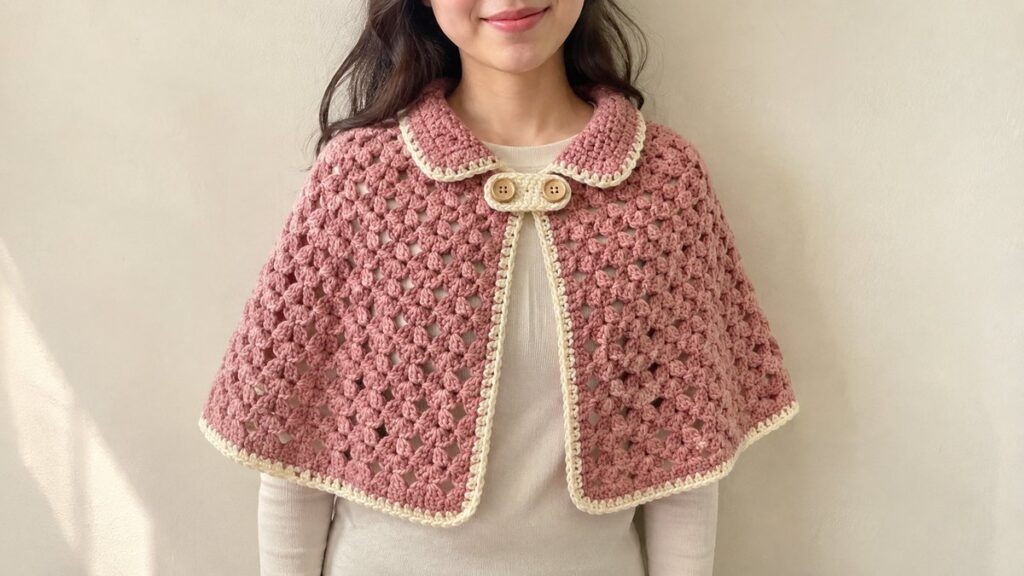
This article follows one cape: the Enchanted Dreams Cape by Two Brothers Blankets, a vintage style cape in worsted weight yarn, worked top down with a textured tri-square stitch, a collar, a contrasting trim, and a buckle at the front. Every number in the printable pattern comes from that design.
The cape starts with a chain of 55 at the neck. The first row works 54 half double crochet stitches, and then increase rows grow the body to 72 stitches, then 96, 120, 144, and 168 for the largest size. The smallest size stops after 96 stitches, the next after 120, and so on. After the increases, plain half double crochet rows set the length, and the textured stitch takes over for the lower body.
The texture is the heart of this cape: a small basketweave style stitch made with front post and back post double crochet in groups of three, worked in alternating rows. It looks rich and handmade. Read the original free design on Two Brothers Blankets.
The same cape can look different with a change of color: over a dress it is a vintage finishing layer, and over jeans it is a cozy layer for a cold day.
For the simplest version, work the cape in one color and use the contrasting color only for the trim and the buckle. You skip extra color changes, have fewer ends to weave in, and the tri-square texture does all the talking. A single soft color, like dusty pink or cream, looks calm and classic. For another simple one-color garment, see our crochet cardigan.
The printable pattern uses a worsted weight (4) yarn in a main color and a contrasting color. The sample uses Hobby Lobby I Love This Yarn, and Lion Brand Pound of Love is a good substitute. You need about 710 yards (649 m) for XS, 800 yards (732 m) for S, 950 yards (869 m) for M, and 1100 yards (1006 m) for L. You also need an I/9 (5.5 mm) hook, scissors, a measuring tape, a darning needle, and two 1 inch buttons.
Gauge is 14 half double crochet stitches and 10 rows to 4 inches (10 cm). Check your gauge before you start the body: too loose, go down a hook size; too tight, go up. The cape fits a 28 to 30 inch (71 to 76 cm) bust in XS, 32 to 34 inches (81 to 86 cm) in S, 36 to 38 inches (91 to 97 cm) in M, and 40 to 42 inches (102 to 107 cm) in L. Work the textured rows until the garment reaches 22 inches (56 cm), or the length you want. For a second free cape design in a different stitch, see the Forest Tales cape on Sandra Stitches.
The sample cape is a soft dusty pink with a contrasting trim. A calm wardrobe may love cream with a grey trim. A bold cape may prefer burgundy with a cream trim, or teal with a rust trim. Keep the trim close to the main color for a quiet look, or far from it for a clear contrast.
The finish is what makes this cape look complete. Work the collar in single crochet for 10 rows, then work three rounds of single crochet trim in the contrasting color around the whole garment, with two single crochet stitches in each corner stitch. Block it if you can: lay it flat, shape it gently, and let it dry.
A crochet cape is open at the front and fastens there, shaped from the neck down, with a collar. A poncho is a closed piece with a hole for the head and no front opening. A cape stays on the shoulders and leaves the arms free.
This crochet cape comes in four adult sizes: XS, S, M, and L. It fits a 28 to 30 inch (71 to 76 cm) bust in XS and a 40 to 42 inch (102 to 107 cm) bust in L. The pattern is written for the smallest size, with larger sizes in parentheses.
A smooth worsted weight (4) yarn is a strong choice: it holds the textured stitch clearly, it drapes well, and it is warm without being heavy. The source pattern uses Hobby Lobby I Love This Yarn, and Lion Brand Pound of Love works well too.
This cape is rated Intermediate, because the tri-square stitch uses front post and back post double crochet, and you need to check your gauge and follow the increase rows by size. The stitches themselves are simple: chains, half double crochet, double crochet, and single crochet.