Learn to Crochet
 Get the Free Crochet Magic Ring Pattern
Join the CrochetRooms newsletter to download the free printable PDF pattern.
Every round project starts with a center, and the center shows its quality. The crochet magic ring is the adjustable loop that pulls that center closed, so no stuffing peeks through a toy and no gap opens at the top of a hat.
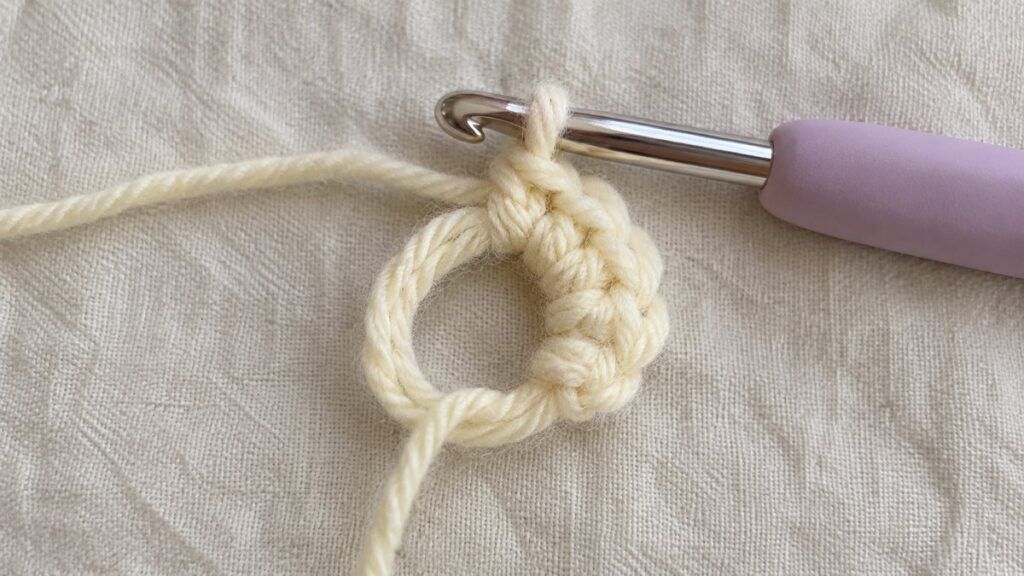
The ring itself is only a loop of yarn, with no stitches of its own. The first round is worked into it, over the loop and the yarn tail together, and the tail pulls the circle shut at the end of that round.
A chain start leaves a fixed hole: a ring that cannot get any smaller, so the middle of your first round stays open forever. For a flat motif that hole can look deliberate, but for a stuffed toy it is a flaw, and the stuffing shows through.
The magic ring stays adjustable until the moment you choose to close it: work the first round into a loose loop, pull the tail, and the center disappears. That is why it is the standard start for amigurumi.
This article follows one technique: the magic ring as taught by June Gilbank at PlanetJune. The demonstration piece is a small circle: a first round of 6 single crochet into the ring, and a second round of 2 in each stitch, which makes 12. Every number in the printable guide comes from that demonstration.
The chain 1 that secures the ring does not count as a stitch in single crochet. Count it, and your first round would hold 7 stitches instead of 6, and every round after it would be wrong.
The old start: chain 2, work 6 single crochet in the second chain from the hook, then 2 in each stitch around. The counts match the demonstration, 6 growing to 12, but the center is a loop of chain that never closes. One center is shut tight, the other has a hole you can see through.
A chain of 4 joined with a slip stitch leaves even more space in the middle, which suits a lacy motif and fails a stuffed toy.
Anything worked in the round can start with a magic ring, but some projects need it more. If the center will be seen or stuffed, close it.
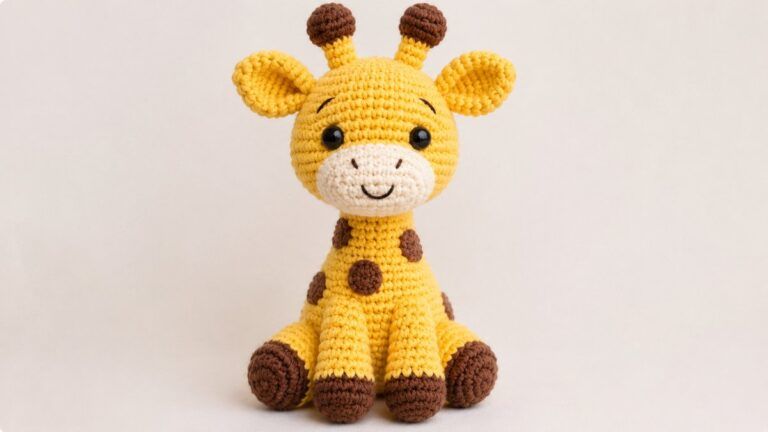
Amigurumi is where the magic ring earns its name. Every head, body, ear, and limb of a stuffed toy begins as a small circle that starts with a ring that pulls shut. Our amigurumi crochet collection is full of toys that begin this way, and our crochet octopus is a good first project: its head opens with a magic ring of 6 stitches.
Hats worked top down, granny squares, mandalas, coasters, and rugs all begin in the round. A hat crown started this way has no drafty hole at the top, and a granny square center sits flat and neat.
Hands are different, and the ring has more than one road to the same loop. The printable guide shows the standard method in full, plus two more: the X method, which many beginners find easiest, and the tabletop method, which uses a flat surface. All three end in the same place: a loop, a securing chain, a first round of stitches, and a pull of the tail that closes the center. Hobbii shows three ways to form a magic ring, and its finger wrap method matches the standard method in our guide.
Taller stitches change one detail: for half double crochet the securing chain is 2, and for double crochet it is 3, and with taller stitches that chain counts as the first stitch of the first round.
Practice with a smooth yarn in a light color and a hook that matches the yarn label, to see every loop clearly. Dark or fluffy yarn hides the ring while you are learning. A stitch marker helps in spiral rounds, which have no join to mark the end of a round.
The first round is the whole lesson: 6 single crochet into the ring, pulled shut, then 2 in each stitch to reach 12. That little circle is the opening round of the demonstration piece.
The magic ring is not right for every project. Flat work in rows never needs it, and a pattern that starts with a chain is written around that chain. A lacy motif can prefer the open center of a chain ring, where the hole is part of the design. And a ring that must hold weight or take hard wear is better as a double ring, two loops instead of one.
We have written the full magic ring guide as a printable PDF, with the standard method in full, two more ways to form the ring, and the practice rounds with their stitch counts checked twice. It is free for our newsletter subscribers, and the PDF downloads from this page after you subscribe. Read the original free guide on PlanetJune.
Yes, in crochet the two names mean the same thing, and magic loop is used the same way in patterns. Any pattern that says magic circle or magic loop means this same ring.
It depends on your pattern. The demonstration in our guide works 6 single crochet into the ring for the first round, then 2 in each stitch for the second round, which makes 12. If your pattern calls for a different number, work that number instead.
Not when the first round is worked in single crochet. The chain 1 secures the ring, and the first round holds 6 stitches. With taller stitches the rule changes: a chain 2 for half double crochet, or a chain 3 for double crochet, counts as the first stitch of the first round.
Yes, in almost any pattern worked in the round. If a pattern starts with a chain, replace it with a magic ring and a chain 1, then work the first round into the ring as written. For joined rounds, slip stitch into the first stitch at the end of the first round, then chain 1 to begin the next round.