Accessories
 Get the Free Printable PDF Pattern
Join the CrochetRooms newsletter and we’ll email you the printable PDF version of this pattern.
Table of Contents
A crochet shawl is the most elegant thing you can make with one skein-heavy project and a single stitch pattern. It drapes over evening dresses, warms chilly offices, and folds into a gift that looks far more expensive than the yarn it took. Once you understand the triangle construction, you can make crochet shawls forever in any yarn you like.
Below I am sharing my free crochet triangle shawl pattern: how the top-down construction works, the alternating solid and lace sections that give it its look, the yarn and gauge you need, and how to size it up or down. At the end, you can grab the full pattern as a printable PDF.
Scarves come and go with fashion, but the crochet triangle shawl has been in style for centuries. It flatters every body, fits every size without grading, and works in every season: light yarn for summer evenings, wool for winter. It is also the perfect travel project, one piece with no seams and nothing to assemble at the end.
For a maker, the crochet shawl is pure rhythm. Once the increase pattern clicks, your hands work on autopilot and the rows fly by. If you love wraps and neckwear, pair this project with our classic cozy crochet scarf for a complete handmade cold-weather set.
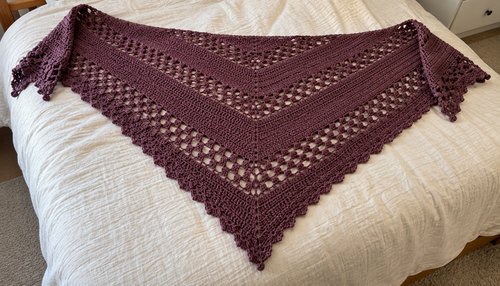
This is a top-down triangle: you start at the center of the long top edge and work outward in turning rows, increasing at three points, the two side edges and the center spine, on every row. Those three increase points are what turn a rectangle into a triangle, and they never change no matter which stitch pattern you use.
The solid sections are plain double crochet, worked with 3 double crochet in the first and last stitch of each row and a (2 double crochet, chain 2, 2 double crochet) group in the center chain space. Each solid row adds 4 stitches, so the triangle grows steadily and the fabric stays warm and opaque. A similar classic top-down build is shown in Love Life Yarn’s beginner triangle shawl.
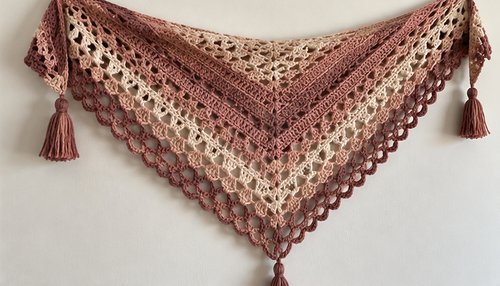
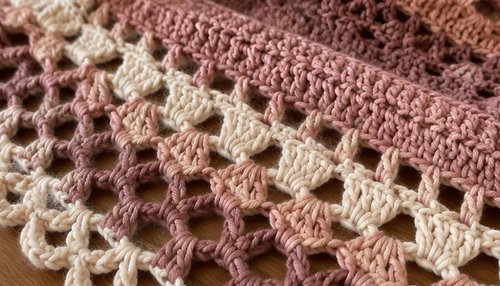
Between the solid bands, open mesh rows of (double crochet, chain 1) keep the crochet shawl light and give it that elegant, airy look. The mesh is worked over the same three increase points, so the triangle keeps its shape while the fabric opens up. The contrast between solid and lace is what makes the finished shawl look designed rather than plain, and it is much easier than it looks: if you can double crochet and chain, you can work the lace.
Use a fingering-weight (#1) yarn, about 850 yards (775 m), with a US G-6 (4.0 mm) hook. The gauge is 15 double crochet stitches and 13 rows per 4 in (10 cm), the same gauge used for Blue Star Crochet’s Beatrix triangle shawl. A smooth yarn with good stitch definition shows off the lace sections best; KnitznPurlz’s easy triangle shawl shows the same construction in a heavier yarn if you prefer a chunkier wrap.
Color choice changes everything. A solid color looks classic and elegant; a long-gradient cake yarn paints its own stripes across the sections with no ends to weave in. Avoid very dark colors for your first shawl, they hide the lace pattern and make counting harder.
The finished crochet shawl measures about 66 in (168 cm) across the wingspan and 20 in (51 cm) deep at the center spine, after blocking. That is a generous wrap size: it covers the shoulders fully and crosses in front with room to spare.
Want it bigger or smaller? Just add or remove repeats of the solid and lace sections. Each 4-row repeat adds about 4 in (10 cm) to the wingspan. Stop whenever the top edge reaches your target width, then work the scalloped border. This adjustability is the beauty of top-down triangles: the pattern fits any size because you are the measuring tape.
Drape it over your shoulders with the point down your back for the classic look, or wrap it bandana-style with the point in front for extra warmth. A simple shawl pin or brooch at the front turns it into evening wear, and it layers beautifully over our crochet headband and crochet mittens for a full winter set.
It also makes a spectacular gift. A shawl fits the recipient no matter what, needs no sizing information, and looks impressive the moment it comes out of the tissue paper.
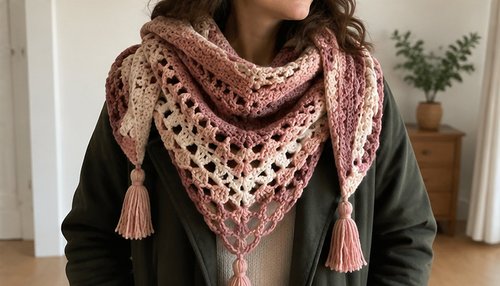
Ready to make your own? I wrote the complete Crochet Shawl pattern as a printable PDF: the top-down triangle with alternating solid and lace sections, exact stitch counts for every solid row, the mesh repeat, and the scalloped border, plus blocking and sizing notes. It is free for our newsletter subscribers, so use the signup box at the top of this article to get your copy.
What size is the finished crochet shawl?
About 66 in (168 cm) wingspan by 20 in (51 cm) deep at the center spine, after blocking. You can make it larger or smaller by adding or removing section repeats.
What yarn and hook do I need?
Fingering-weight (#1) yarn, about 850 yards (775 m), with a US G-6 (4.0 mm) hook.
What is the gauge?
15 double crochet stitches and 13 rows per 4 in (10 cm). Match this gauge so your shawl comes out the intended size.
Is a triangle shawl beginner-friendly?
Yes, it suits an advanced beginner. The whole crochet shawl uses double crochet, chains, and the same three increase points on every row.
Do I need to block the shawl?
Blocking is strongly recommended: it opens up the lace sections, evens the edges, and gets you to the full 66 in wingspan. Pin it out, mist or soak it, and let it dry flat.
How can I make the shawl bigger?
Add more repeats of the solid and lace sections before the border. Each 4-row repeat adds about 4 in (10 cm) to the wingspan; have extra yarn on hand if you supersize it.