Home & Seasonal
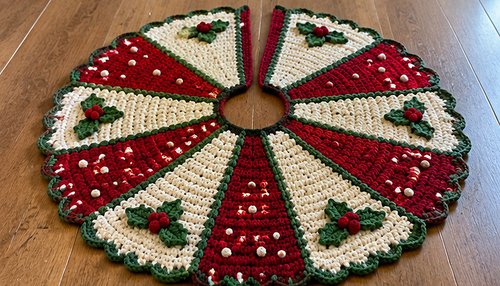
 Get the Free Printable PDF Pattern
Join the CrochetRooms newsletter and we’ll email you the printable PDF version of this pattern.
Table of Contents
A crochet tree skirt is the finishing touch your Christmas tree has been waiting for. It hides the stand, catches the pine needles, and turns the base of the tree into part of the decoration instead of an afterthought.
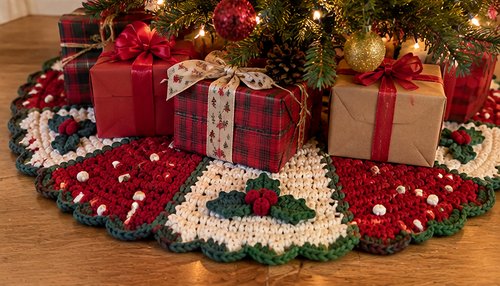
Below I am sharing my free crochet tree skirt pattern: a classic round skirt worked outward from the center in twelve gentle wedges, finished with a scalloped edge and a back slit with ties so it slips around any tree. At the end, you can grab the full pattern as a printable PDF.
The tree gets all the attention in December, but the base is what your eye lands on when you walk into the room. A store-bought skirt does the job, yet a handmade crochet tree skirt adds texture and warmth that flat fabric skirts cannot match. It also becomes part of your family’s Christmas story, since the same skirt comes out of the box year after year.
It is also a wonderfully practical project. The stitchwork lies flat under the branches, worsted yarn shrugs off pine sap, and if a corner gets crushed in storage you can steam it back into shape. For a fully handmade tree, pair it with ornaments from your own hook, like our chunky crochet snowflake.
This crochet tree skirt starts at the center and grows outward in flat circular rows, a little like a giant doily. You begin with a short foundation chain that forms the trunk opening, then increase evenly on every row until the skirt reaches about 42 inches across.
Twelve evenly spaced increase points shape the circle, one per wedge. Each row adds exactly twelve stitches, so the math stays simple: row 2 has 48 stitches, row 3 has 60, and the increases continue in the same twelve spots all the way out to 396 stitches. Because the increases stack in the same places, the skirt grows as a smooth round without ripples or cupping. If your edge ever starts to wave, your stitch count has drifted, and counting back to the last increase row will find the problem.
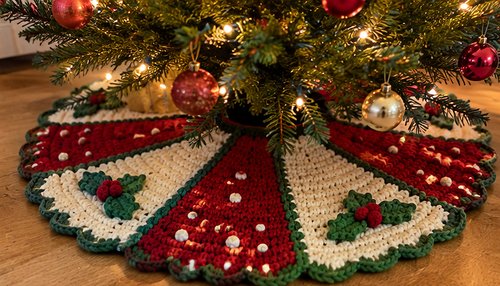
Instead of joining rounds, you turn at the end of every row. That leaves a straight slit running from the center opening to the outer edge, which is exactly how the skirt gets around the tree trunk. A quick row of single crochet along each slit edge keeps it neat, and four crocheted ties, two at the trunk and two at the hem, hold it closed. There is no cutting and no sewing shut, and the tree stand stays hidden behind the fabric.
Use a worsted-weight (#4) yarn with a US H-8 (5.0 mm) hook. That pairing is the classic choice for tree skirts: it is the same combination Petals to Picots uses for her 46-inch granny square tree skirt, and it gives a sturdy fabric that still drapes softly. The gauge is 12 double crochet stitches and 7 rows per 4 inches. After row 4 (72 stitches), the work should measure about 24 inches around the curve; if yours is wider, try a smaller hook.
The finished crochet tree skirt measures about 42 inches (107 cm) across, which suits most 6 to 7.5 foot trees. You will need approximately 1,400 yards (1,280 m) of worsted yarn, so buy it all at once and check that the dye lots match. A solid red, cream, or forest green looks timeless, while a variegated yarn paints its own stripes across the wedges with no ends to weave in. If you prefer a super-chunky look, The Hook Nook’s classic tree skirt uses bulky yarn and a P hook for a faster, heavier version.
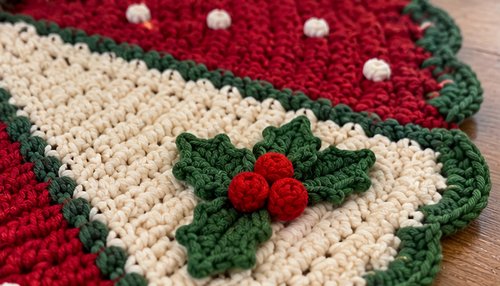
Lay the skirt with the slit at the back of the tree and tie the inner ties snugly around the trunk. Fluff the scalloped edge so it ripples a little; a perfectly flat skirt looks less inviting than one with soft folds. Tuck the outer ties under the hem so they disappear from view.
For a coordinated tree, echo the skirt color in a few ornaments. Our crochet snowman looks right at home beside a red skirt, and snowflake ornaments in the same cream as a cream skirt tie the whole tree together. Wrapped gifts in matching paper finish the picture, and our crochet Christmas tree pattern makes a sweet miniature to set beside the big one.
Ready to make your own? I wrote the complete Crochet Tree Skirt pattern as a printable PDF: the 42-inch round skirt with twelve increase wedges, row-by-row stitch counts, the scalloped edge, slit finishing, and ties. It is free for our newsletter subscribers, so use the signup box at the top of this article to get your copy.
What size tree does a 42-inch crochet tree skirt fit?
A 42-inch skirt suits most 6 to 7.5 foot trees, real or artificial. As a rule of thumb, the skirt should span roughly half the width of the tree’s lowest branches.
How much yarn does a crochet tree skirt take?
About 1,400 yards (1,280 m) of worsted-weight (#4) yarn. Buy it all at once and check that the dye lots match so the color stays even across the wedges.
What hook size do I need?
A US H-8 (5.0 mm) hook with worsted-weight yarn, aiming for 12 double crochet stitches and 7 rows per 4 inches.
How does the skirt get around the tree trunk?
The back slit runs from the center opening to the outer edge. Slide it around the trunk, then tie the four crocheted ties, two at the trunk and two at the hem, to hold it closed.
Can a beginner crochet a tree skirt?
Yes, it suits an advanced beginner. The whole crochet tree skirt uses double crochet, simple increases, and turning chains. The stitches are easy; the project just takes patience, about two weeks of evening stitching.
How do I keep the skirt lying flat?
Count your stitches at the end of each increase row: every row should have exactly twelve more stitches than the last. If the edge ripples, you have added too many increases; if it cups, you have added too few. A light steam blocking also relaxes the fabric.