Blankets
 Get the Free Crochet Temperature Blanket Pattern
Join the CrochetRooms newsletter to download the free printable PDF pattern.
A crochet temperature blanket turns a whole year of weather into stripes: one row a day, in the color of that day’s high temperature, until 365 rows tell the story of your year.
This is the simplest version of the idea: plain single crochet rows in DK yarn with a G hook, in two sizes. No fancy stitches, no shaping.
A temperature blanket is the slowest project you will ever love. One row a day takes about 12 to 17 minutes, so it never feels heavy, yet by December you hold a record of your whole year: the cold snaps and the heat waves. No two blankets ever look alike.
Each day you check the day’s high temperature, find its color, and crochet one row. Row 1 is January 1 and Row 365 is December 31. Miss a day and nothing is lost: write the temperature down and crochet the row later. Keep a small notebook by your hook.
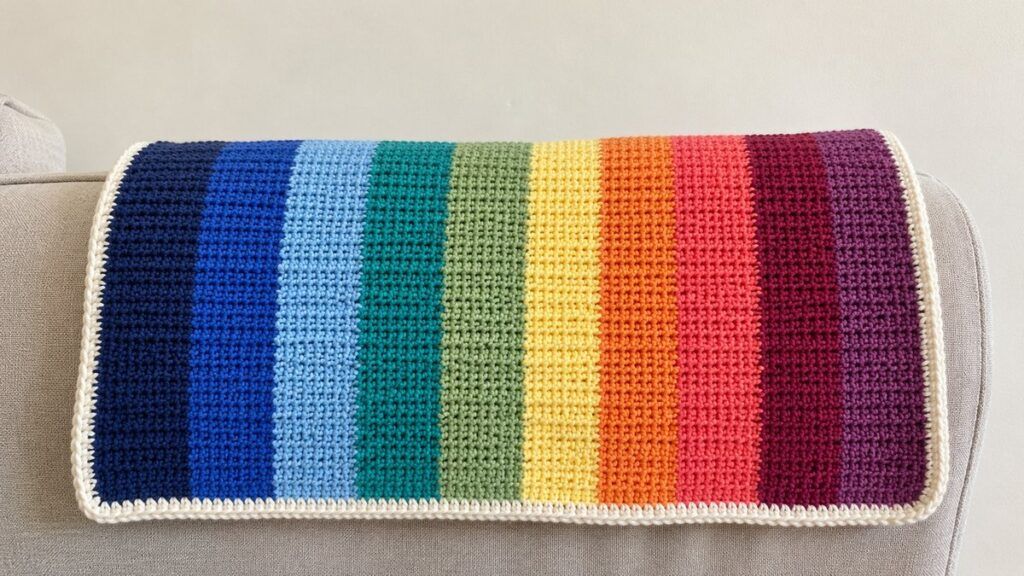
The colors run as a gradient, from deep navy for the coldest days through blues and greens to warm yellows, oranges, and reds for the hottest days. A cold February shows as navy and royal blue, a July heat wave as coral red and burgundy. If your weather is mild, narrow the bands so you use all your colors.
This article follows one design, the Crochet Temperature Blanket 2027 by AMG Royal: plain single crochet in two sizes, a 10 color chart in degrees Fahrenheit, and a cream border. Our earlier temperature blanket is a different worsted weight design. Every number in the printable pattern comes from that design, and the pattern labels every estimate as an estimate.
The foundation chain is 161 chains for the Narrow Throw or 224 for the Throw. Row 1 gives 160 single crochet stitches for the Narrow Throw or 223 for the Throw, and every row after repeats the same row: chain 1, turn, single crochet in each stitch across. The turning chain never counts: work the first single crochet in the first stitch and the last in the last stitch.
The chart has 10 ranges: Deep Navy for 19 degrees F and below, Royal Blue 20 to 29, Sky Blue 30 to 39, Teal 40 to 49, Sage Green 50 to 59, Butter Yellow 60 to 69, Orange 70 to 79, Coral Red 80 to 89, Burgundy 90 to 99, and Plum 100 and above. Change color in the last single crochet of the row: work it until 2 loops are on the hook, drop the old color, and pull the new color through both loops.
The Narrow Throw is about 36 inches (91 cm) wide and about 74 inches (188 cm) long, with 160 single crochet stitches in every row. It uses about 2,680 yards (2,451 m) of DK yarn in all, and takes about 74 hours in total, about 12 minutes a row.
The Throw is about 50 inches (127 cm) wide and about 74 inches (188 cm) long, with 223 single crochet stitches in every row. It uses about 3,720 yards (3,402 m) of DK yarn in all, and takes about 102 hours in total, about 17 minutes a row. For a striped throw with more texture, see our crochet ripple blanket.
The pattern uses DK weight (3) yarn in 10 temperature colors plus cream for the border, with a US G-6 (4 mm) hook. The source names no yarn brand: use any DK weight yarn you like, but use one brand and one dye lot family if you can, because a thinner yarn changes the length. Buy one skein of each color to start.
Gauge is suggested only, not swatched: 18 stitches and 20 rows equal 4 inches (10 cm) in single crochet with DK yarn and a G-6 hook. Make a swatch first: chain 21 and work 24 rows, then measure and count. If your swatch has 22 rows in 4 inches, your blanket will be about 67 inches long instead of 74, because the rows stay 365. Read the original free design on AMG Royal. For a stitch with more texture, our moss stitch crochet blanket shows a pretty single crochet alternative.
Keep the foundation chain loose and place a stitch marker every 25 chains, then count again before the first row. Mark the first single crochet of every row, and count your stitches every week: if the sides ripple, you have too many stitches at the ends, and if they pull in, you are missing stitches. Weave in ends weekly: with 365 rows you will have hundreds of ends.
Keep a log of every day, and catch up a few rows each evening. January Rows 1 to 31, February 32 to 59, March 60 to 90, April 91 to 120, May 121 to 151, June 152 to 181, July 182 to 212, August 213 to 243, September 244 to 273, October 274 to 304, November 305 to 334, December 335 to 365. Look up past highs on timeanddate.com when you fall behind, and mark special days with a metallic or sparkle row.
This crochet temperature blanket has 365 rows, one for each day of the year. 2027 is not a leap year, so the count is exact. In a leap year, February 28 and 29 share one row, so the blanket still has 365 rows.
About 2,680 yards (2,451 m) of DK weight yarn in all for the Narrow Throw and about 3,720 yards (3,402 m) for the Throw, estimated with a 15 percent margin. Plan 220 yards (201 m) per 30 days of one color for the Narrow Throw, or 310 yards (283 m) per 30 days for the Throw.
No. Start any day you like: a birthday, a wedding day, or the first day of school all make lovely start dates. Number your rows from your own first day and the pattern is the same.
Single crochet is the safest choice, because it is the shortest basic stitch. At 20 rows to 4 inches, 365 rows land at a livable 74 inches, while 365 rows of double crochet would make a blanket over 10 feet long.