Blankets

 Get the Free Printable PDF Pattern
Join the CrochetRooms newsletter to download the free printable PDF pattern.
Table of Contents
Crochet ripple blanket is the project that turns one simple stitch into pure magic. Row after row of double crochet rises and falls into soft waves, and with every color change the blanket starts to look like something from a boutique. It is rhythmic, relaxing, and the finished throw looks far more impressive than the effort it takes.
Below I am sharing everything I love about this make: the wave repeat that creates the ripple, the stripe rhythm that makes the colors sing, and the edge trick that keeps everything straight. At the end, you can grab my free crochet ripple blanket pattern to make your own.
The ripple, sometimes called chevron, has been a favorite blanket stitch for decades, and it is easy to see why. The waves form automatically from increases and decreases placed at regular intervals, so you get beautiful texture without learning anything complicated. If you can double crochet, you can ripple.
It is also the ultimate stash-friendly blanket. Because the design is built on stripes, you can work through leftover skeins and the waves will pull the colors together into something cohesive. This pastel chevron blanket from Soofha shows how pretty the ripple looks in soft, blended shades, worked at a 48 by 60 inch throw size just like mine.
Every crochet ripple blanket is built from the same three ideas: a repeating wave, a steady stripe rhythm, and straight edges. Get these right and the blanket practically makes itself.
The wave comes from a 12-stitch repeat: four double crochets climbing up, a three-stitch decrease dipping into the valley, four double crochets climbing again, and three double crochets worked into one stitch to form the peak. The peaks and valleys stack directly on top of each other row after row, which is what keeps the waves even. Counting your stitches at the end of each row is the one habit that guarantees perfect ripples.
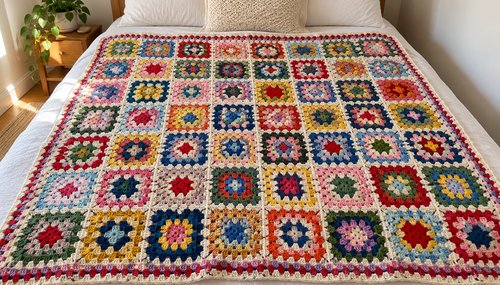
Changing color every four rows gives the classic crochet ripple blanket look: bands of color wide enough to read clearly but narrow enough to keep things lively. Carry the unused colors up the side if you are working with two alternating shades, or fasten off and weave in the ends for a many-colored scrap version. Either way, change colors at the end of a row, never in the middle of a wave. Fans of our granny square blanket layout guide will recognize the same color-planning fun here.
The most common ripple mistake is edges that slant, and it always comes from the turning chain. My pattern starts and ends every row with two double crochets worked into the edge stitch, which keeps the sides perfectly vertical. The ripple stitch blanket guide from Treasurie uses the same multiple of 10 plus 4 logic for sizing, and notes how the stitch count must stay constant for straight sides.
Worsted-weight (#4) acrylic or an acrylic blend is the classic crochet ripple blanket yarn. It is affordable in the quantities a throw needs, it washes well, and the slight spring of acrylic makes the waves pop. Choose four or five colors that share the same tone, all pastels or all jewel tones, for a pulled-together look. Use a US H (5.0 mm) hook for a drapey but sturdy fabric.
My pattern finishes about 48 inches (122 cm) wide and 60 inches (152 cm) long, a generous throw for the couch. It uses roughly 1,800 yards of worsted-weight yarn in total. At a gauge of 16 double crochet stitches and 8 rows to 4 inches, the foundation chain of 197 gives you the full width. For a smaller lapghan, simply work fewer repeats of the 12-stitch wave; for a bed-size blanket, add more. If you loved the texture of our chunky crochet blanket, the ripple gives you the same cozy weight with more visual movement.
A ripple throw is a styling workhorse. Drape it over the arm of a neutral sofa and the waves add instant pattern to the room, or fold it across the foot of a bed for a layer of handmade color. Because the design reads as classic rather than trendy, it fits farmhouse, coastal, and modern rooms alike.
For gifting, a crochet ripple blanket in the recipient’s wedding colors or a baby ripple in soft pastels is always a hit. Pair it with a matching pillow or one of our crochet blanket patterns in a solid stitch for a complete handmade set.
Looking for a crochet ripple blanket pattern free to download? I wrote the complete Crochet Ripple Blanket pattern as a printable PDF: the 48 by 60 inch throw, the 12-stitch wave repeat with straight-edge instructions, and the four-row stripe rhythm. It is free for our newsletter subscribers, so use the signup box at the top of this article to get your copy.
How big is the finished crochet ripple blanket?
About 48 inches (122 cm) wide and 60 inches (152 cm) long, a generous couch throw.
What is the ripple stitch repeat?
A 12-stitch repeat: 4 double crochet, a 3-stitch decrease for the valley, 4 double crochet, and 3 double crochet in one stitch for the peak.
Why are my ripple edges slanting?
The stitch count is changing at the edges. Work two double crochet into each edge stitch and count your stitches every row until the habit sticks.
How much yarn does a ripple throw need?
Roughly 1,800 yards of worsted-weight (#4) yarn in total, split across your stripe colors.
Can I make the blanket wider or narrower?
Yes. Add or remove repeats of the 12-stitch wave, keeping the foundation chain at a multiple of 12 plus 5.
Is the ripple stitch good for beginners?
Yes, if you can double crochet and count. The whole blanket is one repeat worked over and over.