Amigurumi & Toys

 Get the Free Crochet Lavender Pattern
Join the CrochetRooms newsletter to download the free printable PDF pattern.
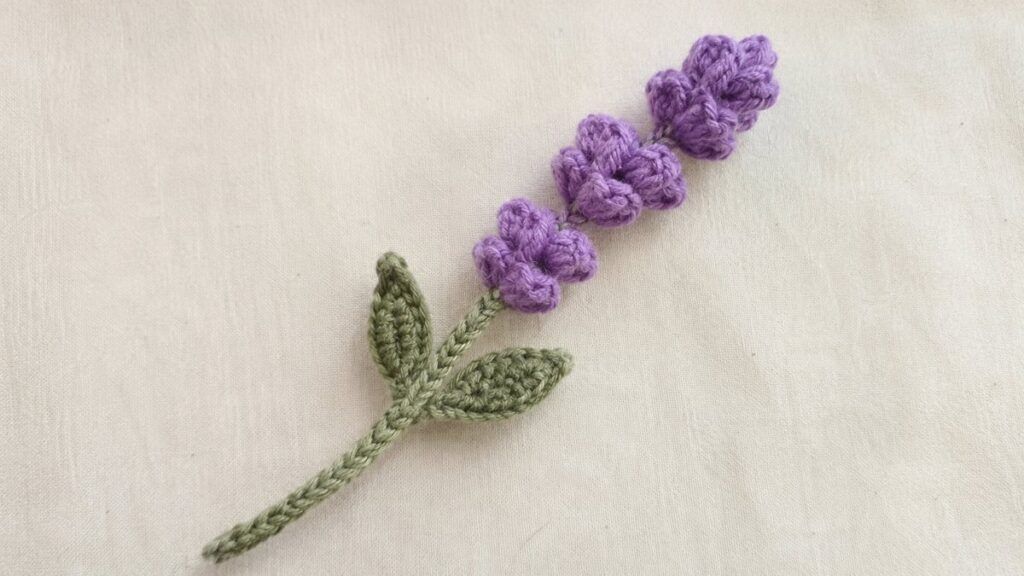
A crochet lavender sprig is the flower that never wilts and never needs water. It is one slim green stem topped with three little purple bud clusters. If you can single crochet in the round, you can make it.
There is no wiring to hide, no safety eyes to place, and no complicated shaping to learn. The whole sprig is four small pieces sewn together: one stem, two leaves, and three round buds. That is the whole flower.
A good first amigurumi flower removes every decision that can go wrong. There is no large piece to stuff evenly and no face to embroider. Each bud is a tiny ball worked in five short rounds, and the stem is a single row of slip stitches.
The structure does the hard work for you. Real lavender is already shaped like a small amigurumi project: a slender stem with small, rounded buds clustered in a loose column at the top. The yarn version copies that shape, so the finished sprig reads as lavender at once.
This article follows one sprig: the Mini Crochet Lavender Amigurumi Flower by Easy DIY. One stem, two small leaves, and three bud clusters, all in DK or worsted weight yarn with a 3.5 mm or 4.0 mm hook. Every number in the pattern comes from that design.
Most crochet flowers are one big bloom with petals fanning out from a center. This crochet lavender works the opposite way. Each bud cluster is a small rounded ball made on its own, starting with 6 single crochet in a magic ring, growing to 12 stitches, then closing down to 4. Three of those little balls sit in a row along the top of the stem, and together they make the clustered spike.
The middle round of each bud is worked in the back loops only, which leaves a small ridge around the ball, the detail that makes the buds look clustered and tight. A tiny pinch of fiberfill inside each bud gives it a gentle dome, although the source pattern says the buds work just as well left unstuffed.
The stem is the simplest part of the sprig. It starts from a chain of 15, and one row of 14 slip stitches worked back along the chain makes a firm, slightly twisted cord. That twist is intentional: it gives the stem a natural quality, like a real lavender stem, and it holds its shape with no wire and no stuffing.
The two leaves are small pointed ovals, each worked from a chain of 6 with 5 stitches down each side, 10 stitches around in all. They sit on either side of the stem, roughly in the middle or toward the lower third. The three buds attach at the top with a small gap of 3 to 4 stitches worth of space between each one, so the spike steps down the stem instead of bunching into one lump.
The pattern uses a small amount of purple or lavender DK or worsted weight yarn for the buds, and green yarn of the same weight for the stem and leaves. Acrylic holds its shape well, and cotton gives a slightly stiffer finish. A single 100 gram ball of each color will make dozens of sprigs. You will also need a 3.5 mm or 4.0 mm hook, a stitch marker, a yarn needle, and scissors, plus an optional tiny pinch of fiberfill.
The source pattern gives no gauge and no finished measurements. If your stitches run loose, drop down to a 3.0 mm hook; if they run tight, go up to a 4.5 mm hook. A tighter fabric keeps the buds neat and stops any stuffing from showing through. Read the original free design on Easy DIY.
One sprig on its own is a sweet little thing, and a small bundle is a gift. Tie three or five stems together with a narrow satin ribbon and you have a handmade posy that costs almost nothing and takes less than an hour, according to the source pattern. Tuck a cluster into a small clay pot or a glass jar for a desk or windowsill.
The sprig is just as happy as an embellishment. Stitch one to a plain greeting card for a card that doubles as a keepsake, add a brooch pin to the back of a bundle, or sew a stem onto a tote bag or a wreath. For a scented version, tuck a small sachet of dried lavender inside a stuffed bud before you close it. Our crochet tulip makes a taller companion stem in the same vase, and our crochet sunflower adds a bold bloom beside the soft purple spikes. For a lavender sachet to match, see the dried lavender sachets at Make and Do Crew, and for another small flower, see our crochet daisy.
Ready to make your own? We have written the full lavender sprig pattern as a printable PDF, with the stem, the leaves, the bud clusters, and the assembly. It is free for our newsletter subscribers, and the PDF downloads from this page after you subscribe.
One sprig is four pieces: a stem of 14 slip stitches from a chain of 15, two pointed oval leaves of 10 stitches each, and three round bud clusters. Each bud starts with 6 single crochet in a magic ring, grows to 12, and closes to 4. The pieces are sewn together with their yarn tails.
A small amount of purple or lavender DK or worsted weight yarn for the buds, and green yarn of the same weight for the stem and leaves. Acrylic holds its shape well, cotton gives a slightly stiffer finish, and one 100 gram ball of each color will make dozens. Use a 3.5 mm or 4.0 mm hook.
One sprig is a quick project, and the source pattern says a bundle of three to five stems takes less than an hour. Each piece is small, so you finish one and move straight to the next.
Yes, it is a kind first amigurumi project. You only need chains, slip stitches, single crochet, half double crochet, and double crochet, plus increases and decreases in the buds. There are no safety eyes, no wiring, and no large stuffed pieces.