Blankets

 Get the Free Printable PDF Pattern
Join the CrochetRooms newsletter and we’ll email you the printable PDF version of this pattern.
Table of Contents
At first glance, a mosaic crochet blanket looks like the hardest thing in the room. The geometric diamonds and zigzags seem to shift color mid-row, the kind of colorwork you would expect from a loom, not a hook. Then you learn the secret: you only ever hold one color at a time. That is the whole magic of mosaic crochet, and once it clicks, you will wonder why you waited so long to try it.
A mosaic crochet blanket is a colorwork blanket worked in overlay mosaic technique, and it is one of the most satisfying projects in crochet. You get bold, graphic results with beginner-level stitches, no tangled bobbins, and none of the mid-row color changes that make other colorwork feel fussy.
Overlay mosaic crochet uses just two stitches: single crochet worked in the back loop only, and a taller double crochet that drops down into the front loop of the stitch two rows below. Every row uses only one color. You work with the right side always facing you, fasten off at the end of every row, and rejoin the next color at the start. The tall dropped stitches lay over the rows beneath them, and those overlapping stitches are what draw the pattern.
That is genuinely the entire technique. There are no mid-row color changes, no carrying a second yarn across the back, and no turning the work. A mosaic crochet blanket builds its design one clean row at a time, and each row is simple enough to crochet while half-watching a show. Designers like Elsie at HookByElsie have built entire collections on this method, showing how far two balls of yarn and two stitches can go.
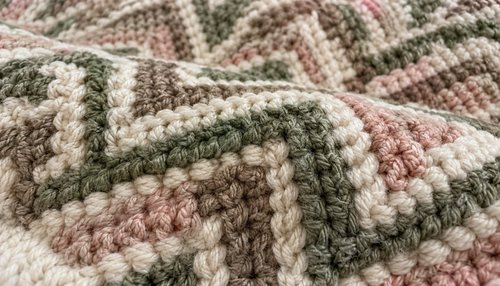
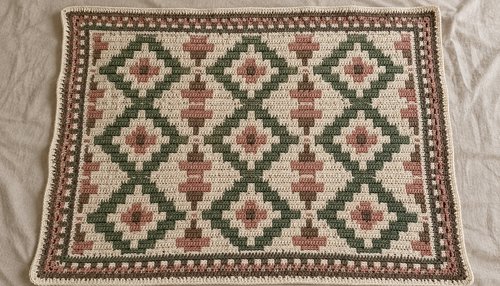
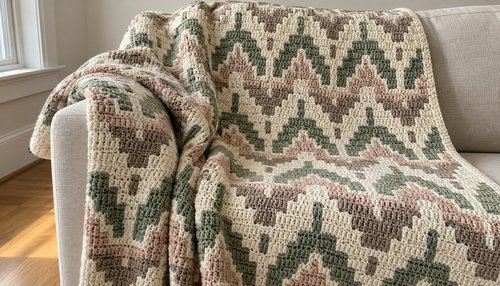
The dropped double crochets create a woven, almost kilim-like texture that plain colorwork cannot imitate. Because the tall stitches overlap the rows below, the shapes have depth and crisp edges: diamonds, zigzags, interlocking borders, and chevrons that look printed rather than crocheted. High-contrast color pairs, like cream against a deep jewel tone, make the geometry pop.
It also photographs beautifully, which is why the mosaic crochet blanket keeps going viral every winter. A finished throw draped over a couch reads as modern heirloom, the kind of piece people ask where you bought. Yet nothing about it is beyond a confident beginner. The stitches are easy; following a chart for many rows is the only real skill involved.
Mosaic patterns are usually chart-based, with one square per stitch: a blank square means single crochet in the back loop, and a marked square means a dropped mosaic double crochet. Good patterns also write out every row, so you can follow the chart, the text, or both. Many designs are built on a repeating block, for example a 24-stitch by 24-row repeat, which you work again and again until the blanket reaches full length.
Before committing to a full throw, make a swatch. A 20-row test square teaches you the one special stitch, confirms your gauge (a common one is 14 stitches and 15 rows per 4 inches in mosaic pattern with a 5 mm hook), and shows you how your colors look together. A row counter and two stitch markers for the edges will save you more frustration than any fancy notion.

You need two yarns with strong contrast between them, because the whole design depends on the eye reading the two colors separately. The classic pair is a solid light color, like warm cream, with a darker contrasting solid or a multicolor cake with long color changes. Here is a lovely trick: pair cream with one long-change multicolor and every band of the pattern lands on a different stretch of the cake, so the blanket seems to recolor itself while you hold a single ball.
Worsted-weight yarn with a 5 mm (US H-8) hook is a great starting point for a mosaic crochet blanket: warm, durable, and easy to find. Expect a full throw to use roughly 3,000 yards total, split between the two colors. Plan your budget before you start, and buy the full amount in one dye lot. Browse our Blankets collection for more throw ideas, or look through all our patterns while your swatch is on the hook. For a free introduction to the technique, Juniper and Oakes ran a full summer mosaic crochet-along with charts and video tutorials.
Ready to try it? We wrote our own original overlay mosaic throw pattern as a printable PDF, with the full 24-row chart repeat written out row by row, real gauge and yardage, and a counted border that encases every end as you go. It is free for our newsletter subscribers. Just use the signup box at the top of this article.
Not as hard as it looks. You only need chain, single crochet, and double crochet. The challenge is following a chart across many rows, not the stitches themselves. Most crocheters call it intermediate, but adventurous beginners do it all the time.
No, and that is the best part. Each row uses exactly one color. The colorwork effect comes from the dropped double crochets overlapping previous rows, not from changing colors mid-row.
Overlay mosaic is worked flat with the right side always facing you, cutting the yarn at the end of each row, using dropped stitches for the pattern. Inset mosaic is worked in the round or with a different stitch structure. For blankets, overlay is the most common method.
It is a slow, relaxing project. A full throw can take around 60 hours of stitching, so think weeks of evening crochet, not a weekend. The rhythm becomes automatic after the first repeat, which is why so many people call it addictive.
A full-size throw in worsted weight uses roughly 3,000 yards total, split between the two colors. Buy one extra skein of each color so you never run short on the border.
Check your yarn label. Most acrylic throws can be machine washed on gentle and laid flat to dry. Wool blends should be hand washed in cool water to keep the colorwork crisp.