Blankets

 Get the Free Printable PDF Pattern
Join the CrochetRooms newsletter to download the free printable PDF pattern.
Table of Contents
Crochet throw blanket projects are the coziest middle ground in crochet: bigger than a lap blanket, faster than a bed-size afghan. A throw lives on the couch arm, ready for movie nights and chilly mornings, and most patterns work up in a simple repeating stitch you can memorize in an evening.
Below I am sharing everything I love about this make: the sizes that actually fit a couch, the stitches that look impressive with little effort, and the yarn and hook details that matter. At the end, you can grab my free crochet throw blanket pattern to make your own.
A throw is the blanket you actually use every day. At roughly 40 to 50 inches wide and 48 to 60 inches long, it covers your legs on the couch without swallowing the whole sofa, and it folds small enough to drape over one arm. That everyday usefulness is why throws are the most gifted blanket size: everyone has a couch, and everyone gets cold on it.
Throws are also wonderfully forgiving to make. Most are simple row repeats you can resize by changing the starting chain, so the pattern bends to your yarn stash. If you like textured row work, our moss stitch crochet blanket uses the same kind of meditative repeat at a smaller scale.
A good throw blanket has three parts: a stitch with rhythm, clean edges, and the right drape. Each one has a simple rule behind it.
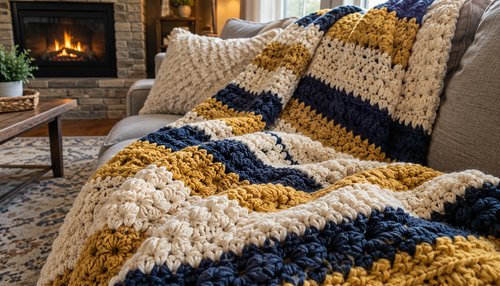
The best throw stitches look textured but work on autopilot. The Colorado Throw from Mama in a Stitch mixes crossed double crochet eyelets with half double crochet through the front loop only and raised front-post braids. Prefer something simpler? The Spider stitch is just (sc, ch1, sc) all in one stitch, and the V-stitch is two double crochets in the same stitch. This Colorado Throw from Mama in a Stitch shows how rich crossed and post stitches look in chunky yarn.
Straight edges make a throw look store-bought. Count your stitches at the end of every few rows, keep your turning chains consistent, and the sides will stay even from the first row to the last. The Colorado Throw finishes with just two rows of single crochet along the two long edges, which is all the framing a busy texture needs.
Drape comes from the yarn and hook pairing. A chunky #5 yarn on an 8 mm hook gives a soft, relaxed fabric, while a worsted #4 on a 6.5 mm hook makes a denser, warmer throw. Swatch a few inches first: if the fabric feels stiff, go up half a millimeter in hook size until it softens.
Worsted-weight (#4) yarn is the most common choice for throws, with chunky (#5) a close second for faster projects. The Colorado Throw uses Lion Brand Hue and Me, a Chunky Weight #5, about 1,000 grams (9 skeins of 125g), with a US L (8.0 mm) hook, finishing 40 x 48 inches. A worsted option is the Highland Falls Throw: Caron Jumbo Ombre, size 4 worsted, 1,950 yards (4 skeins of 595 yards), with a US K/10.5 (6.50 mm) hook, finishing 48 x 60 inches. The Sunset Stroll Throw lands in between at 44 x 51 inches in a worsted ombre with an 8.0 mm hook.
Across real patterns, throws run about 40 to 50 inches wide and 48 to 60 inches long, using roughly 900 to 2,200 yards depending on yarn weight and size. Most throw patterns are rated Easy, though textured versions like the Colorado Throw suit crocheters already comfortable with the basics. Resizing is easy: start with any even number of chains and repeat the row pattern until the throw is as long as you like.
Keep a throw folded over the couch arm and it will get used daily. Drape one across the foot of a bed, keep one by your reading chair, or roll one up in the car for road trips. Ombre and variegated yarns do all the colorwork for you, so a gradient colorway looks hand-dyed with zero ends to weave in.
Throws make generous, welcome gifts. Choose the recipient’s favorite colors in a soft, washable yarn, and add a simple single crochet border in a coordinating shade to pull it together. For a matching set with a different texture, our crochet waffle stitch blanket pairs beautifully with a smooth v-stitch throw.
Looking for a crochet throw blanket pattern free to download? I wrote the complete Crochet Throw Blanket pattern as a printable PDF: the textured row-repeat stitch, the even-numbered chain resizing method, the simple edging, and real size guides from 40 x 48 inches up to 48 x 60 inches. It is free for our newsletter subscribers, so use the signup box at the top of this article to get your copy.
What size is a crochet throw blanket?
Real patterns range from 40 x 48 inches (a small throw) to 48 x 60 inches (a generous throw), with 44 x 51 inches in between. Most throws fall about 40 to 50 inches wide and 48 to 60 inches long.
How much yarn does a throw blanket need?
About 1,000 grams of chunky #5 for a 40 x 48 inch throw, or about 1,950 yards of worsted #4 for a 48 x 60 inch throw. Plan on roughly 900 to 2,200 yards across the size range.
What is the easiest stitch for a throw blanket?
The V-stitch and the Spider stitch are both rated Easy and work up fast. Textured options like crossed double crochet and front-post stitches look richer but need you to be comfortable with the basics first.
Should I use worsted or chunky yarn?
Worsted-weight (#4) is the most common and gives a dense, warm throw. Chunky (#5) works up noticeably faster and makes a softer, drapier fabric. Both are good choices.
How do I resize a throw blanket pattern?
Most throw patterns let you start with any even number of chains for the width, then repeat the row pattern until the throw reaches the length you want. Check the pattern’s stitch multiple first.
Can a beginner make a throw blanket?
Yes, if you pick an Easy-rated pattern with a simple repeat like V-stitch or Spider stitch. Save the textured post-stitch versions for after you are comfortable with basic stitches.