Blankets

 Get the Free Printable PDF Pattern
Join the CrochetRooms newsletter to download the free printable PDF pattern.
Table of Contents
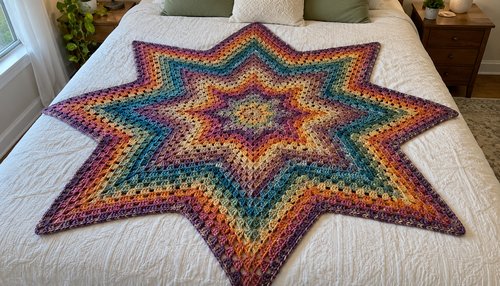
Crochet star blanket patterns turn a simple ring of stitches into a real eight-pointed star. Worked from the center outward, each round adds a new ring of points, so the blanket grows into its shape row by row. My favorite version finishes about 35 inches from point to point, which makes a perfect baby blanket, and the same construction scales up to a generous 68-inch throw.
Below I am sharing everything I love about this make: the clever center-out construction, the shell-stitched points, and the yarn and hook pairings that keep every star lying flat. At the end, you can grab my free crochet star blanket pattern to make your own.
Most blankets grow in straight rows, but a star blanket grows in a circle that keeps surprising you. Round after round, the points rise a little higher and the valleys dip a little deeper, until one day you lay it flat and there is a perfect star on your lap. That moment never gets old, no matter how many you make.
Star blankets are also some of the most gifted blankets in crochet. A star-shaped baby blanket is an unforgettable shower gift, and a big star throw draped over a couch looks like a designer piece. If you enjoy blankets with bold geometry, our crochet ripple blanket uses a similar valley-and-peak rhythm in rows instead of rounds.
A good star blanket has three parts: a tidy center, crisp points, and smooth valleys. Each one has a simple rule behind it.
Every star blanket begins with a magic ring at the very center, and the work grows outward in rounds. One lovely detail from the Tassel Star Blanket by Made From Yarn: the work is turned after every round, which keeps the texture even on both sides. This crochet star blanket from Made From Yarn shows the full 29-round pattern with its turning rounds and colorwork panels.
The points are formed with shell stitches, usually (2dc, ch2, 2dc), worked into the chain-2 spaces of the previous round. Each round adds stitches at the points while the valleys stay narrow, so the star keeps its shape as it grows. Stars come in many point counts: 6, 7, 8, and even 12 points, as Rhondda Mol shows in her roundup of free crochet star blanket patterns at Oombawka Design.
The valleys between the points are shaped by skipping stitches, usually 2 stitches between the double crochet groups, which pulls the fabric inward at exactly the right spots. Colorwork loves this construction: in the Tassel Star Blanket, eight color panels begin at Round 7, one per point, in Pastel Blue, Yellow, Light Grey, and White. Keep your tension even across color changes and the panels will look painted on.
Medium-weight (#4) worsted yarn is the most common choice for star blankets. The 8 Point Star Afghan from Meladora’s Creations uses Medium Weight [4] with a 5 mm (H) hook, while the Hugs and Kisses Starshine Afghan pairs Medium Weight [4] with a 5.5 mm (I) hook for a 68-inch span. For a quick baby star, Super Bulky [6] yarn with an 8 mm (L) hook finishes the Dreamtime Star Baby Blanket at about 38 inches point to point, and Bulky [5] with a 6 mm (J) hook makes the 63.75-inch Sleep Under the Stars blanket.
Typical sizes run from about 34 to 41 inches point to point for a baby star, with 38 inches the classic Bernat baby star diameter, up to 50 to 72 inches for a lap or throw star. One smart tip from the 6-Day Star Blanket by Betty McKnit: start with the hook size on the yarn label, but keep a 0.5 mm and a 1 mm larger hook on hand in case the points start to curl. Star blankets suit advanced beginners and up, since the center-out shaping and stitch counting at the points take a little practice.
A star blanket is a showpiece wherever it lands. Lay a baby star on the nursery floor as a play mat, drape a throw star over the couch arm with one point hanging down, or fold one at the foot of a guest bed. The shape does all the decorating work for you, so solid or softly striped colorways look best.
Finish the points with personality. The Tassel Star Blanket adds eight 3.5-inch tassels, one per point, while the Sleep Under the Stars blanket tops each of its 12 points with a pompom. For holiday gifting, pair a star blanket with pieces from our christmas decor collection for a handmade seasonal set.
Looking for a crochet star blanket pattern free to download? I wrote the complete Crochet Star Blanket pattern as a printable PDF: the center-out 8-point construction from a magic ring, the shell-stitch points, the valley shaping, and real size guides from a 35-inch baby star up to a 68-inch throw. It is free for our newsletter subscribers, so use the signup box at the top of this article to get your copy.
How big is a crochet star blanket?
Baby stars typically measure 34 to 41 inches point to point, with 38 inches the classic Bernat baby star diameter. Lap and throw stars run 50 to 72 inches across the points.
What yarn weight is best for a star blanket?
Medium-weight (#4) worsted is the most common. Super Bulky [6] makes a fast baby star, and Bulky [5] works well for larger throws.
What hook size should I use?
Match the hook to your yarn, usually 5 mm (H) to 8 mm (L). The 6-Day Star Blanket tip is worth remembering: keep a 0.5 mm and a 1 mm larger hook nearby in case the points curl.
Why are my star points curling?
Usually the hook is too small or the tension is too tight for the stitch count. Switch to a larger hook and the points will relax and lie flat.
How many points can a star blanket have?
Common versions have 6, 7, 8, or 12 points. More points make a rounder, more intricate star, while fewer points make bolder, graphic shapes.
Can a beginner make a star blanket?
It suits advanced beginners and up. You need a magic ring start, center-out shaping, and careful stitch counting at the points, but each skill is easy to learn on its own.